Vietnamese refugee and exile status
The SympathizerVietnamese refugee and exile status is both a political rupture and a continuing condition in the novel: people who had been citizens of a country become displaced dependents, dispersed across the United States, and uncertain whether return remains possible. The experience is not one uniform passage from escape to safety. It includes bereavement, state-managed resettlement, precarious work, separated communities, improvised cultural life, and the persistence of political commitments that exile cannot settle.
From citizens to refugees
After landing on Guam, The unnamed narrator helps place Duc on a stretcher, unable at first to lay the child on the tarmac. Medics cover Duc and Linh with white sheets and take mother and son away while Bon weeps inconsolably. The family has lost not only its home but its future: Bon is catatonic, and the narrator grieves for his godson, whom he had regarded as the closest thing he might have to a son. The deaths make displacement intimate and bodily before it becomes a question of policy or identity.
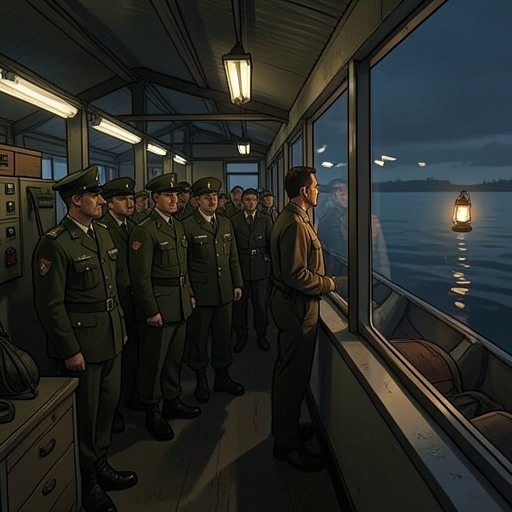
The evacuees watch images of helicopters lifting people from Saigon to aircraft carriers; the next day, communist troops raise the National Liberation Front flag over the presidential palace. At the refugee barracks, the decisive change arrives through an everyday act: returning cafeteria trays. The narrator understands that the refugees are no longer adult citizens of a sovereign country, but stateless people protected, for the moment, by the American military. The General attempts to raise morale by walking among the tents in uniform, but civilians meet him with silence, then attack him with a slipper. His rank, once a sign of authority, now marks the distance between the former regime and people who have also lost their country.
Camps, sponsorship, and precarious settlement
After Linh and Duc are buried together, Bon throws himself into their open grave, asking why they died instead of him. The narrator climbs in to calm him, then helps cover the coffins with earth. On Guam, grief unfolds amid the larger mourning of thousands; the refugees’ collective wailing makes the camp seem like a funeral for a nation. They are later transferred to Camp Pendleton, where barracks replace the tents of Camp Asan. The narrator reads the improved facilities ironically as an early dividend of the American Dream, while the camp also functions as a boot camp for the rigors of learning American life.
Resettlement depends on sponsorship rather than on a common destination. The narrator secures support through Professor Hammer, who finds him a clerical job in the Department of Oriental Studies and raises money for his move to Los Angeles. With those funds, he pays for a bus ticket, a few motel nights, an apartment deposit near Chinatown, and a used 1964 Ford. He then searches for a sponsor for Bon, eventually finding one through a storefront church. By September, the two men are reunited in a small apartment, where Bon works nights as a janitor for cash and receives welfare. The narrator presents that aid not as simple dependency but as a bitterly practical recompense for a soldier who had fought in an American-determined war and whose military skills have no ready civilian market.
Other exiles occupy similarly constrained positions. The crapulent major works as a gas-station attendant in Monterey Park, paid in cash so he can remain eligible for welfare; his wife sews in a sweatshop, and their twins receive the American names Spinach and Broccoli. The comic naming conceals a serious hope that the children will grow strong enough for a country their father considers unforgiving. The contrast between former status and present employment is repeated across the community: military rank, professional experience, or family responsibility does not guarantee security in the new country.
A dispersed diaspora
In the first year after leaving the camps, the narrator writes letters ostensibly to Man’s aunt in Paris, using agreed-upon topics and invisible ink to carry messages to Man. At that stage, he reports that the exiled soldiers are in no condition to mount a counterstrike, so the intelligence is useful but does not require secrecy. The correspondence shows exile extending across borders: ordinary letters serve as a channel between the United States, Paris, and Vietnam, even while distance and clandestine politics shape what can be said openly.
The refugees themselves are scattered by administrative decisions. Some arrive as individuals, some as intact families, and others after their families have been divided. Many are sent to states whose names are unfamiliar to them, and they adapt those names to their own English pronunciations. Before leaving camp, they exchange addresses and telephone numbers, building an informal network to learn where jobs, welfare, lower racism, and Vietnamese neighbors might be found. The narrator imagines what they could have made by remaining together: a self-sufficient community spanning trades, professions, religions, regions, and political allegiances. Instead, they are dispersed, and the possibility of a collective Little Saigon is denied by bureaucratic fiat.
Dispersal does not erase social life. Small groups gather in basements, churches, backyards, and beaches, bringing groceries rather than paying for food at concessions. Reliance on Chinese markets alters familiar dishes; without the right fish sauce, even food becomes an imperfect recollection of home. In crowded rooms, refugees trade stories that range from exploitation, family separation, suicide, and violence to scholarships, new work, and unexpected success. A stranded movie star finds help only after Tippi Hedren responds to her desperate appeals and flies her to Hollywood. These stories keep loss and possibility in circulation, but they do not restore the nation they evoke. The community clings to the belief that the country is not dead even as exile makes that belief harder to sustain.
Time, return, and the sea
A hardwood clock carved in the shape of Vietnam gives the displaced condition a striking image. Its hands turn in the south, with the dial’s numbers arranged around Saigon. The object makes a homeland into a timepiece: for those separated from it, the distance of return is finite, but the years required to close that distance may be infinite. The question of when they can go back becomes more defining than the miles between them and home. The narrator’s observation that the clock is set to the wrong time carries the joke of a correction but also the disorientation of a life whose old measures no longer hold.
The novel’s final movement returns the narrator and Bon to Saigon, where they prepare to leave again by sea. They and The Navigator’s family plan to travel by bus to a village south of the city, cross by skiff, and join a fishing trawler carrying about 150 people. The departure is clandestine and physically dangerous: most passengers are expected to hide in a hold designed for far fewer bodies, with little air and no assurance of survival. Gold hidden in the narrator’s rucksack will pay their fares; beside it, they carry a cipher and the confession manuscript, described as their attempt to represent themselves against those who have represented them. The refugees’ passage is not presented as a completed rescue but as a wager made under conditions of repression and uncertainty.
The name boat people troubles the departing group because it seems to reduce them to an anthropological curiosity, as though they were a primitive people emerging from the sea. They refuse pity as the defining description of their lives, without claiming that hardship has made them immune to turning away from other unwanted people. Their final insistence on survival sits beside, rather than erases, the losses and political contradictions that have shaped their exile. The promise to live gives the status its unresolved ending: displacement remains dangerous, but it has not extinguished either solidarity or the search for a future.